

Imagine you’re a gold prospector in the Wild West of the Internet. You have your shovel (your website) and a river full of opportunities (Google & Co.). But instead of blindly digging through the mud, you’d like a map that shows you exactly where the gold nuggets (your ideal visitors) are hidden. That’s exactly what keyword analysis is—your treasure map to SEO success!
Best practice checklist for keyword analysis

The world of keyword research offers a wide range of possibilities —from simple, free methods to sophisticated, paid tools.
To give you an overview, I've put together a table that categorizes various approaches and tools based on their costs.
| method | In vain | Inexpensive | Expensive |
|---|---|---|---|
| Google Autocomplete | Enter search terms into Google and note down the suggestions. | – | – |
| Google Keyword Planner | Free with Google Ads account, provides search volume and competitive data | – | – |
| AnswerThePublic | Limited free searches; displays questions and phrases | Premium version for more searches | – |
| Competitor analysis | Analyze H1 headings and meta descriptions from competitor sites | – | – |
| Mangools | Limited free searches per day | Subscription-Based Keyword Analysis Tool | – |
| SEMrush | – | – | Comprehensive keyword analysis, competitive analysis, content ideas |
Free keyword research tools often provide only a superficial picture of the actual search landscape. Nevertheless, these tools are very valuable, especially for beginners.
You should view investing in a good keyword tool as a strategic decision. It gives you an informational edge and helps you better organize and prioritize your work.
The harsh truth about SEO without keyword research

Let's be honest: many of us have tried to do search engine optimization on our own without doing any research. We've written articles that we thought were brilliant, only to find that they disappeared into the depths of Google's search results.
Pretty frustrating, right? The problem was that we were in the dark, not knowing what our target audience was actually looking for.
Without thorough keyword research, SEO is like archery while blindfolded. You can draw the bow and shoot the arrow, but the chances of hitting the target are slim to none.
The harsh truth about poor keyword research and optimization

Poor keyword optimization can be just as disastrous as no optimization at all. Here are the most common pitfalls you should definitely avoid:
Keyword Stuffing – The Road to SEO Hell
People used to think that the more often you crammed a keyword into a text, the higher you'd rank. Wrong! It's like trying to squeeze an elephant into a Mini Cooper—not only does it look ridiculous, but it just doesn't work.
Example: “Buy shoes here! Our shoes in this area are the best. Shoes in all sizes. Shoes, shoes, shoes!”
Sounds terrible, doesn't it? Google thinks so too and penalizes this kind of behavior by banishing it to the last pages of the SERP. Instead, you should focus on natural language and the contextual use of keywords.
The Importance of Understanding and Taking into Account Your Entire Keyword Universe

A common mistake is to focus only on a few relevant “main keywords” and lose sight of the big picture in the process.
Your keyword universe includes:
- Local (/regional, national, or international) keyword variations (e.g., “Pizzeria Berlin Mitte” instead of just “Pizzeria”)
- Keywords for service pages (e.g., “Gold mining worldwide”)
- Keywords for landing pages (e.g., “free precious metals analysis”)
- Keywords for blog posts (e.g., "Gold Panning Tips for Beginners")
The trick is to present this entire universe of keywords on your website in a way that’s logical, helpful, and promotes sales. Think of your website as a well-organized library where every book (every page) has its perfect place. If you manage to cover everything clearly and effectively, you’ll be rewarded with visibility and reach.
The importance of serving the right search intent
One aspect of keyword research that is often overlooked is the search intent behind search queries. Not every user who searches for high-volume keywords, such as “shoes,” actually wants to buy shoes.
Some users who enter the term may be looking for care tips. Others may be searching for information on the history of shoe manufacturing. Finding the right keywords as part of a keyword analysis should not be taken lightly.
Example of the most common types of keywords
- "Buy shoes" → Transactional search intent
- "How do I care for leather shoes?" → Informational search intent
- "Best Running Shoes 2024" → Commercial search intent
These search intentions can also be assigned to the ToFu, MoFu, BoFu principle (Top of Funnel, Middle of Funnel, Bottom of Funnel):

- ToFu (Awareness): “What are the benefits of running shoes?” → Informational search query
- MoFu (Consideration): “Comparison of Adidas vs. Nike Running Shoes” → Commercial search query
- BoFu (Decision): “Buy Adidas Ultraboost 21” → Transactional search query
Common mistakes:
- Ignoring the search intent
- Mixing different search intentions on one page
- Optimizing all pages for transactional keywords
Simple optimization options for beginners:
- Analyze the top 10 search results for your target keyword
- Identify the prevailing, relevant search intent
- Adapt your content accordingly
- Consider the position in the sales funnel (ToFu, MoFu, BoFu)
Why good keyword analysis is your SEO game changer

Imagine you could read the minds of your potential customers. You would know exactly which words they use when searching for products or services like yours. That's exactly what a good keyword analysis does for you!
- You speak your customers' language: No more complicated technical terms—just the words your target audience actually uses.
- Find niches: Discover keyword gold mines that your competitors have overlooked.
- You plan strategically: You know exactly what content you need to create to have the greatest impact.
- You'll save time and money: No more wasting resources on content that no one is looking for.
The Art of Keyword Alchemy in 2025
NLP – When Google Reads Between the Lines
Compared to the era of keyword spam, Google has become significantly smarter. Thanks to natural language processing (NLP), the search engine understands the context and meaning behind the words.
Example: So instead of repeating “buy shoes” a hundred times in your actual text, you should write it in a more natural and user-friendly way, as follows:
“Discover our wide selection of footwear. From elegant pumps to sturdy hiking boots —you’ll find the perfect pair for every occasion here.”
Google gets it: This is about shoes, without you having to spell it out.
Keyword Clustering – Group Yourself for Success

Think of your keywords as a large family. There are siblings, cousins, and distant relatives. Keyword clustering during your keyword analysis brings them all under one roof.
Example: Main keyword: “coffee maker”
Clusters: “espresso machine,” “filter coffee maker,” “capsule machine,” “fully automatic coffee maker”
By using these related terms in your content, you show Google that you are covering the topic comprehensively. Here are some ways you can effectively integrate keyword clustering into your SEO strategy:
- Organize your website by topic: Use keyword clusters to plan your website structure and information architecture.
- Optimize content for entire clusters: Instead of optimizing individual keywords, create comprehensive content that covers an entire keyword cluster.
- Improve internal linking: Link thematically related pages within a cluster to one another.
- Identify content gaps: Analyze your keyword clusters to find topics you haven't covered yet.
The Keyword Golden Ratio – Find the Nuggets

In the world of keyword alchemy, there is a magic compass that shows you exactly where the gold nuggets are hidden: the Keyword Golden Ratio (KGR). This method helps you find long-tail keywords where competition is minimal and which can bring you quick rankings. Instead of aimlessly panning for gold, the KGR shows you the spots in the river where the nuggets are just waiting to be picked up.
How the KGR works
Imagine you have a chart with two key pieces of information: the number of gold prospectors (competition) and the size of the gold nuggets (search volume). With the KGR, you combine these two factors in a simple formula to determine whether the search is worth it:
- Number of search results (with the keyword in the title):
Go to Google Search and enter your keyword in quotation marks, followed by intitle:, to find out how many pages have that exact keyword in the title. The fewer search results, the better! Example: intitle:“best coffee maker for home” - Size of gold nuggets ( monthly search volume):
Use tools such as Google's Keyword Planner, Mangools, or SEMrush to determine the monthly search volume of your keyword. The higher the search volume, the more valuable the find.
A quick reality check before you dive right in: Manual counting via Google is becoming increasingly inaccurate—sometimes real results are missing, and other times incorrect ones are included. If the exact number is important to you, don’t rely blindly on a manual Google search; instead, use a tool like Mangools, which provides a more reliable count. The basic idea behind KGR remains spot on, though: Low competition combined with sufficient search volume is—and always will be—a strong signal.
Evaluation of the KGR:

- KGR < 0,25:
Jackpot! Bei diesen Suchbegriffen liegt das Gold praktisch direkt unter der Oberfläche. Du wirst schnell in den Suchergebnissen nach oben klettern und organischen Traffic generieren, wenn Deine Seite ordentlich aufgebaut und gut optimiert ist. - KGR between 0.25 and 1.0:
Good chances, but you'll have to dig a little deeper. There is competition, but with effort and diligence you will find your gold nuggets. - KGR > 1.0:
This is a highly competitive search term. The field is teeming with other gold diggers. It's going to be tough to strike it rich in this area.
The Reality of the Gold Rush—It Takes Time!

Note: Finding the best keywords can be a long and arduous process. If you analyze each keyword manually, you’ll quickly realize that this gold-rush-style task can take days or even weeks. While the process is often rewarding, it can also be very exhausting.
WriterZen – My high-tech detector for keyword gold
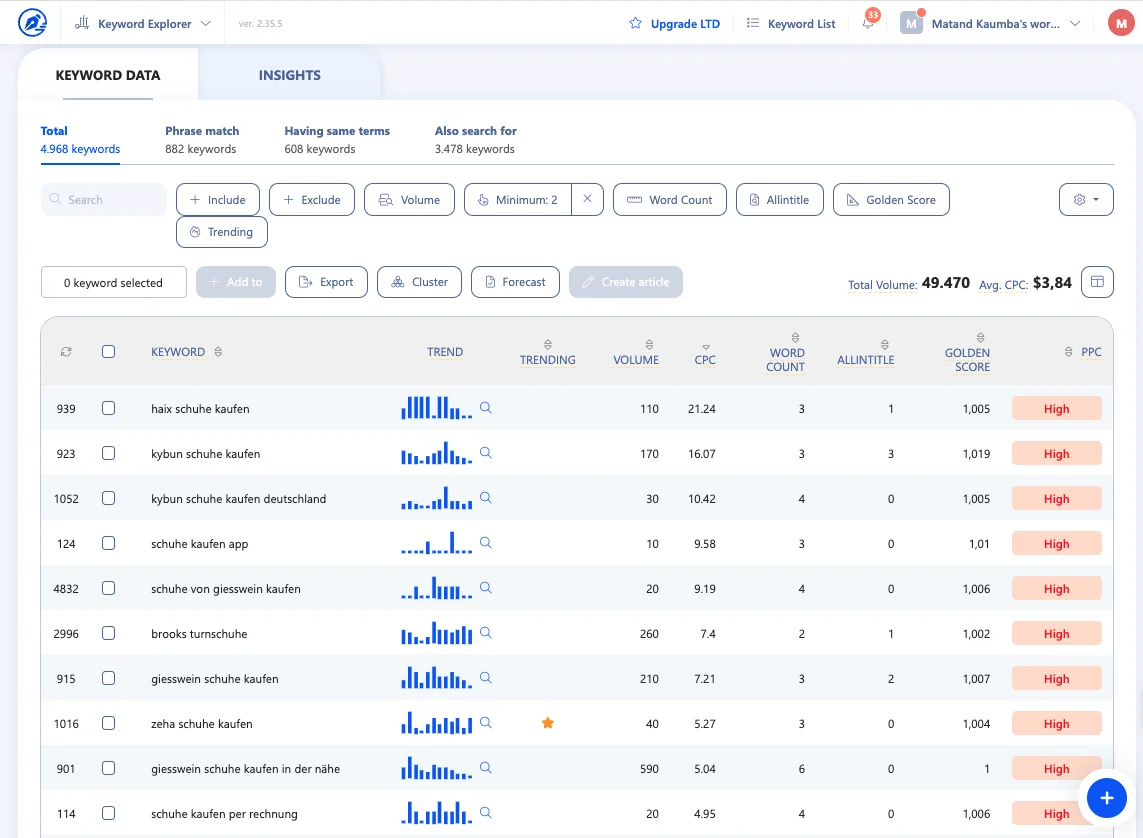
Luckily, you don't have to dig with your bare hands. I use WriterZen as my state-of-the-art gold detector. This SEO tool analyzes the entire internet using the KGR metric and instantly shows me the most valuable keywords.
This lets you find in minutes what traditional SEO agencies would otherwise take days to do—and you can start digging right away. Let me know if you need any help with this.
Conclusion: Unleash the power of keyword analysis

I hope you now understand that thorough keyword research acts like a compass, guiding you straight to the treasures of traffic and conversions.
Do you feel the pull of possibilities?
Imagine finding the right keywords and knowing exactly what kind of content will draw your target audience in like a magnet. No more fumbling in the dark, no more wasted resources—just targeted, effective SEO that leaves your competition in the dust.
But be careful: the road to keyword mastery is paved with pitfalls and challenges. Wrong decisions can sometimes set you back months, while your competitors pass you by.
Do you want to take that risk?
Or are you ready to take the decisive step and improve your SEO strategy with the help of a reputable SEO agency ?
Here are your next steps:
- Join our free Klickdojo community. Here you’ll find course materials, a checklist for keyword optimization, and the chance to exchange ideas with like-minded people.
- If you're ready to revolutionize your keyword strategy and benefit from years of expertise, then our SEO Bootcamp Audit is your path to success. Here, we don’t just conduct a detailed keyword analysis—we’ll walk you through your website’s current status and work with you to develop a customized strategy that will catapult you to the top.
The time to act is now. Every day you wait is a day your competition is overtaking you. Take the initiative and turn your website into an SEO gold mine!